Artist Talk + Screening: Italian Artists’ Films
- 15 May 2026
Opening reception: Thursday 14 May 2026, 6–8pm
Rebecca Moccia’s exhibition is a material, filmic and spatial representation of her research on the subject of nostalgia. A new multi-channel video work is integrated within fragmented parts of a monumental sculpture, creating a sprawling, unwieldy form that materialises the sensorial experience of nostalgia. While Moccia focuses on nostalgia as a characteristic of contemporary anxiety shaped by neoliberal socio-economic systems, Nostalgism is grounded in the artist’s personal and familial experiences, and the twentieth-century history of her home city of Naples, Southern Italy.
The origins of nostalgia mirror the emergence of Western modernisation and the onset of the Industrial Revolution. The emotional state was initially described by Swiss medical student Johannes Hofer as a diagnosis for conditions experienced by mercenaries enrolled in wars across Europe. Their symptoms of depression, fatigue and insomnia led to a new understanding of acute homesickness caused by an intense yearning to return to the communities of their homeland. In this era, those vulnerable to nostalgia included soldiers and workers forced to move from their rural homelands to urban contexts for the requirements of industrial labour and military service. Present day nostalgia is associated with the familiar, idealised and bittersweet feelings brought by the past being reanimated through endless remakes, reissues and comebacks in the culture media canon and era-specific trends. It can be criticised for being an emotionally regressive refusal or inability to adjust to the reality of the present moment. From an alternative perspective, nostalgia can provide the security of feeling that one’s authentic self is consistent across time, by identifying with emotions experienced in the past.
While the emotional and psychological impacts of nostalgia are crucial to Moccia's work, she seeks a deeper understanding of how it has become an inherited historical device that can define the ambitions, ideas, and emotions of a population. When exploited by economic, political and class systems, nostalgia can impact and define society and cultural identity over generations. The feeling’s associations with belonging, and its ability to allow people to cope with distress, are easily abused by those with capital or political interests to govern and direct emotions in order to reinscribe existing societal codes and drive nationalistic ideological interests. Complex and divisive politics of affect are also reflected in Moccia’s previous long-term project The Ministry of Loneliness, which similarly investigates the governance of emotional states of being within a neoliberal infrastructure.
The subject and crucial protagonist in Nostalgism is the city of Naples, Moccia’s birthplace and the site of great geological, militaristic, political, industrial, cultural, and touristic disorder over the past century. As an important access route to Southern Italy, Naples was bombed during the Second World War and, in 1943, invaded by the Nazis. The following year, the most recent eruption of Mount Vesuvius took place, witnessed by the US troops stationed in the city, and documented in detail by the BBC. Many mountainside villages were damaged and some destroyed by lava and ash deposits, forcing individuals such as Moccia’s grandmother to migrate to the bustling city of Naples below. After the war, Naples suffered from the effects of poverty, crime, emigration, and industrialisation, exacerbated by enduring socio-economic divisions that historically emerged with the unification of Italy between the north and south of the country.
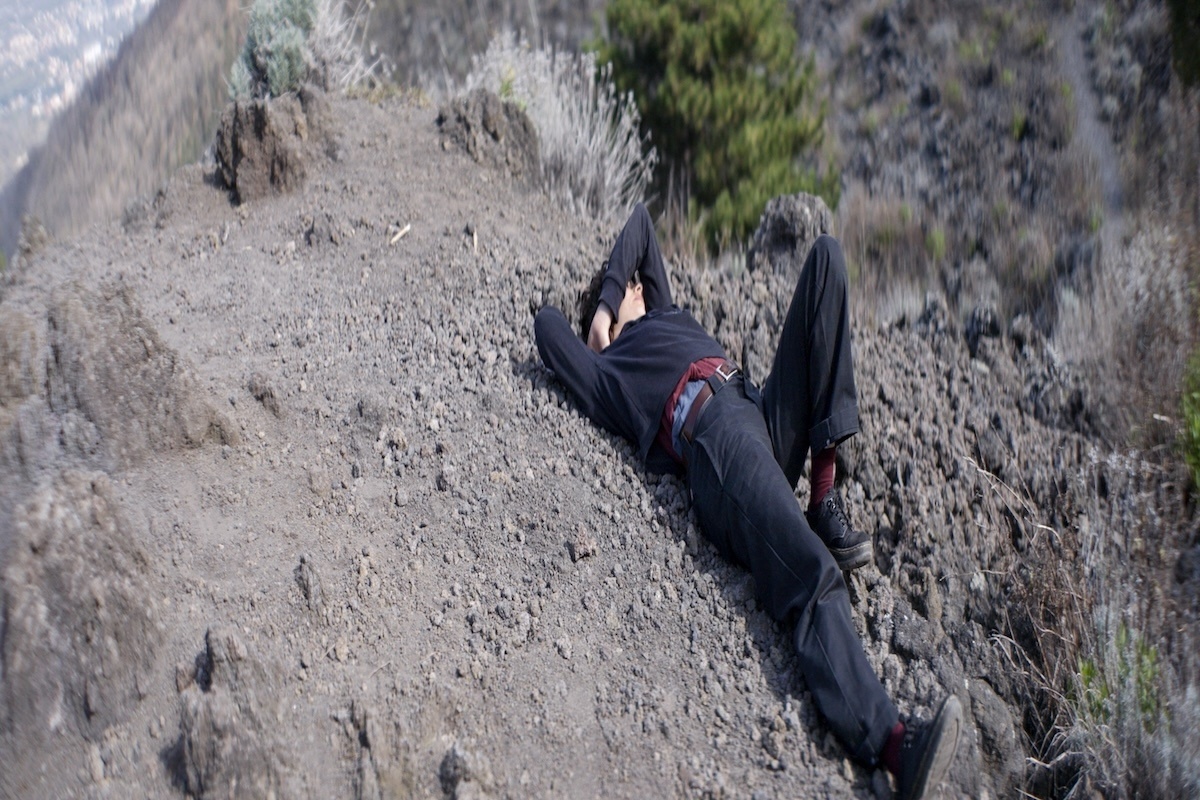
Nostalgism adopts a situated perspective, with Moccia returning to her generational home to reorient herself with its material and emotional legacies. Moccia asks if nostalgia can ever cease to be a psychological label and become a methodology instead. As well as in-depth academic study, Moccia’s primary research processes involve collecting and discussing social histories from the south of Italy, recovering family photographs, re-mapping the streets of her childhood from memory, and psychogeographical walks through significant urban and rural environments of Naples, which provide an embodied phenomenological experience of nostalgia. The work is co-authored with the artist’s family members, who give formal and informal contributions to the research. They take roles in planning, selecting locations, filming scenes, and recreating gestures from archival photographs and films gathered by Moccia, such as a reclining US soldier and a hand holding volcanic rocks on the slopes of Vesuvius. As stated in Vincenzo Estremo’s poetic essay, which is integrated into Moccia’s moving-image installation, “To reach the core of the simulacrum of our lives, we must burrow through a pile of debris. Not the archive, but rather the stones in the palm of our hand.” Nostalgism exists as an active, living project that continues to evolve through discursive events and new configurations. The physical presentation of the exhibition follows a dispersed pathway of related yet disconnected elements, reflecting histories of displacement and dislocation experienced by many over the past century. Although the work features and is made in collaboration with family members, Moccia refrains from a purely sentimental perspective, instead encouraging reflection and acceptance of emotional experiences, as a form of resisting nostalgia-driven exploitation.
The video is displayed across eight analogue and digital screens varying in scale and format, all appropriated from the storage of the Gallery where they otherwise lie dormant between exhibitions. Moccia’s footage also intentionally mismatches video formats, resolution and eras of technology as she films using a range of devices that emphasise lens and image distortion. These formats include digitised footage from a 1990s Video8 camera shot this spring, interspersed with 1980s documentaries on the growth of industrial activities in Naples from the Archivio Audiovisivo del Movimento Operaio e Democratico ETS (Audiovisual Archive of the Workers and Democratic Movement) and BBC news reports from the 1944 eruption of Vesuvius. Much of the contemporary content filmed by Moccia during recent months uses an anamorphic lens that focuses the central subject of the shot while distorting the peripheral edges; a constructive metaphor considering the questions raised about marginalisation in her work.
Vincenzo Estremo’s text sometimes synchronises, overlaps and loops with the video work, creating multiple active timelines, suggestive of the varied and unfixed experience of nostalgia. The text provides an expressive narrative that combines anecdotal and historical research, presented in a fragmented form akin to a memory or eulogy. Estremo describes a journey that weaves between childhood recollections and social history, following the video footage through historic alleyways, remains of factories on the seafront, new touristic developments, an abandoned NATO base, and the smouldering sulphuric crater of Vesuvius. The multi-layered, disordered format of the video playback purposefully complicates and disrupts conventional readings of cultural and societal nostalgia through disjunction and accumulation rather than coherence or closure.
The sculpture, Ancestors Syndrome, comprises several parts of cast aluminium integrated with the Gallery’s architecture replicating shapes and colours derived from a geological map of the 1944 Vesuvius crater and lava flow. Its fluid forms are resolved in a hauntological state between collapse and reconstruction, reflecting the reality of the undetermined and involuntary emotional, social and cultural upheaval. The process of casting aluminium echoes the inherent destruction of the eruption, as molten aluminium is poured into sand-filled moulds. The templates are burnt by the process, ensuring that the resulting parts are uniquely singular components of a fragmented cartography, imprinted with symbols and icons from the original map. The various jumbled arrows, dates and asterixes imply that the Vesuvius eruption is an unreliable marker for a nostalgic starting point for Neapolitan cultural identity. The volcano’s slow geological lifespan far precedes the accelerated technological and cultural development that took place after its eruption, and Moccia’s sculpture signifies a deconstructed moment outside of the accepted timeline of real world events.
The installation’s soundtrack, composed by Renato Grieco, takes an approach to formality and intuition that similarly portrays an unfixed moment in time between the past and present. It is primarily played with a chitarra battente (“strumming guitar”), a traditional rhythmic instrument from Southern Italy that has survived virtually unchanged since the early Baroque period. Grieco’s studio recordings are transduced and transposed through a range of contemporary and obsolete audio formats and systems, to provide a range of sounds that echo processes and technologies across eras. Passages of music are also replayed in reverse presenting a progressive movement into the past, while the digital distortion of this sound is in conflict with the sense of tradition associated with the acoustic instrument. The soundscape occasionally overlaps on itself, unpredictable and dispersed throughout the Gallery, with audio playing from different screens and speakers. At times this is mixed with the present tense reality of street noise outside the building, thus breaking the illusion of nostalgic ambience.
Moccia and Grieco describe the composition as a 'diaspora of memory'. Its relationship to the moving images in the exhibition–which are themselves distorted by the lens of the past–confirm Estremo’s statement that, “reconstructing a world that never existed is not nostalgia”. Moccia is not setting out to fabricate an atmosphere or representation of nostalgia. She instead questions how we can be informed by and participate in forms of nostalgia without falling prey to the artificial authenticity it can present. Moccia invites alternative readings of nostalgia as a way to destabilise narratives of progress imposed by global capitalist, far-right and neoliberal powers. By showing how nostalgia can be materialised, the artist provides a means to position ourselves in the world and within our own selves. Moccia creates opportunities to look to the past in order to find the motivation to face challenges of the present and imagine counter-hegemonic alternative futures.
Rebecca Moccia’s recent exhibitions include Panorama, Pozzuoli (2025); Italian Pavilion, 15th Gwangju Biennale (2024); Galeria Madragoa, Lisbon (2024); Fondazione Sandretto Re Rebaudengo, Guarene (2023); Mazzoleni, Turin (2023); ICA Milano (2023); Jupiter Woods, London (2022). Rebecca Moccia is a PhD Researcher in Visual Arts and Creative Practices at Naples Academy of Fine Arts, and Co-founder of Art Workers Italia.
This exhibition is in partnership with Careof, Milan. Moccia’s new moving image work is produced by Careof, in collaboration with Temple Bar Gallery + Studios, Collezione Agovino, WHITESPACE Projects Napoli, Istituto Italiano di Cultura, Dublin. With thanks to Mazzoleni for their support.
With Annamaria Moccia, Brigida Moccia, Claudio Fontanarosa, Cristina Nasti, Edoardo Moccia, Gennaro Cera, Giuseppe Moccia, Lorenzo Moccia, Nicoletta Moccia, Sara Moccia.
Producer: Marta Bianchi
Cinematography: Vincenzo Marranghino & Rebecca Moccia
Original Soundscape: Renato Grieco
Video Editing: Ilenia Zincone
Color Correction: Giorgia Ripa
Text: Vincenzo Estremo
Translations: Ema Stefanovska
Field recordings: Federico Grieco
Graphic Design: Riccardo Rudi
Residency coordinator: Concetta Luise
Artist Assistant: Francesca Rossi
Video archival materials and research contributions: Archivio Audiovisivo del Movimento Operaio e Democratico ETS, Archivio Russo Somma, Archivio Luce, Circolo Ilva Bagnoli.
Acknowledgments: Riccardo Berrone, Giovanni Capasso, Roberta Capone, Marta Cereda, Stefano Colonna, Antonietta Cocorullo, Pietro Costa, Maria Rosaria Donato, Salvatore Fruguglietti, Marco Di Sante, Stéphane Béna Hanly, Cahir McNicholl, Cris Neumann, Ed Kiely, Linea Bar (Antonio Pronostico, Juta, Fulvio Risuleo, Frita, Andrea Buttazzi, Lola Giffard-Bouvier), Alessandro Nassiri Tabibzadeh, Adrian Paci, Pasquale Parlato, Nicola Vincenzo Piscopo, Tani Russo, Domenico Russo, Nadia Santafede, Emilia Moccia, Mazzoleni.