Interview: Vanessa Donoso López in conversation with Sadbh O'Brien
24 July — 20 September 2026
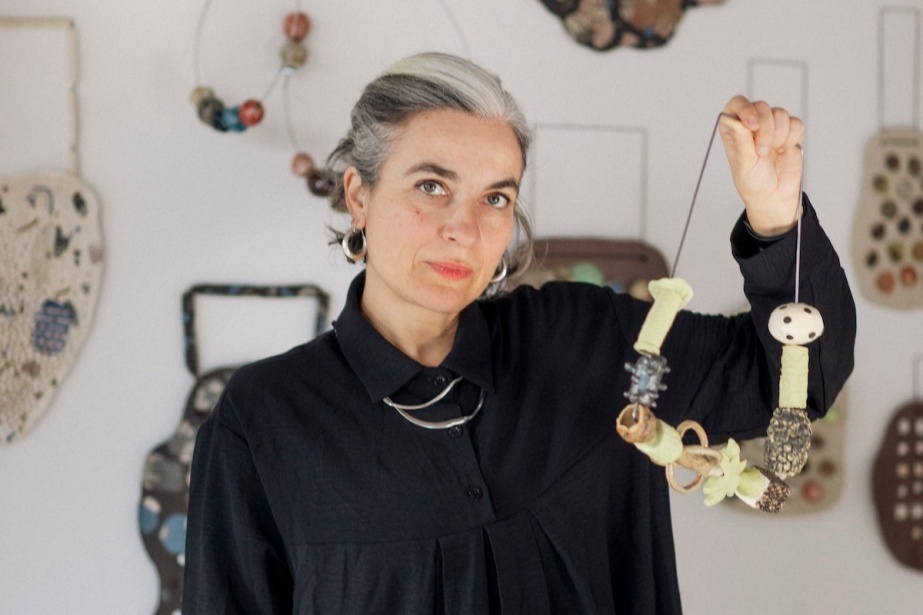
Artist Vanessa Donoso López speaks to TBG+S Communications Manger Sadbh O'Brien about her upcoming exhibition (O-O-O) at TBG+S.
SO: Clay is central to your practice. Could you talk a bit more about your interest in the material, where it started, and where it's taken you?
VDL: Yeah, OK. So in 2003, I moved from Spain to England to do an Erasmus and my life changed in a fundamental way. Everything about my context became altered; the weather, language, architecture, and way of relating to humans. I became very aware that I was in a different place and I took this in a very literal way. I started to look at the land, stones, pebbles, sand, soil, and clay. The material helped me to connect to this new place.
And then I started to research and realised how much power this material has, how much knowledge it holds. All these records it keeps: biological, geological, cultural, archaeological. Clay has been such an important and relevant material throughout history, civilisations and even before. Clay, stones and rocks, they are a witness to it all. I find that really powerful.
SO: So you are interested in how much it has helped our understanding of what came before?
VDL: Exactly. Clay has been so important and relevant throughout history, civilisations and even before. After being fired, it has longevity. Archaeologists have been able to tell a lot about ancient societies through these objects. I started to think more deeply about this material and how relevant it's been, how it's been present through the world’s changes. Dealing with this material which holds all this information, just manipulating it, it feels profoundly significant. It's like, wow, if it could talk.
SO: Yeah, what would it say? It would be astonishing.
VDL: Yeah. And then I started to think of the ways it has helped us progress, such as clay tokens. Clay tokens are these tiny sculptures – simple geometric sculptures – that existed before writing and were used as a form of communication. Let's say, a farmer wanted to send goods to another farmer in a different town. They had this system where, say, a sphere would describe a cow, and a triangle would describe rice. They would make the tokens and would put it in this clay ball called a bulla. They would give it to a courier of sorts and the goods would be delivered to the other farmer, together with the bulla. The second farmer had to break it open and check they corresponded.
SO: Almost like a delivery receipt.
VDL: Exactly like a receipt. And the clay ball was like an envelope. So when I came across them it felt so meaningful. These tokens then were eventually marked on the surface. And eventually they became clay tablets. From these, cuneiform writing evolved, which is the first type of known writing. The oldest piece of literature, the Epic of Gilgamesh, was then written on twelve clay tablets with this cuneiform system. The story is kind of abstract, and it has had many different interpretations, but you can see how the Bible has been inspired by this.
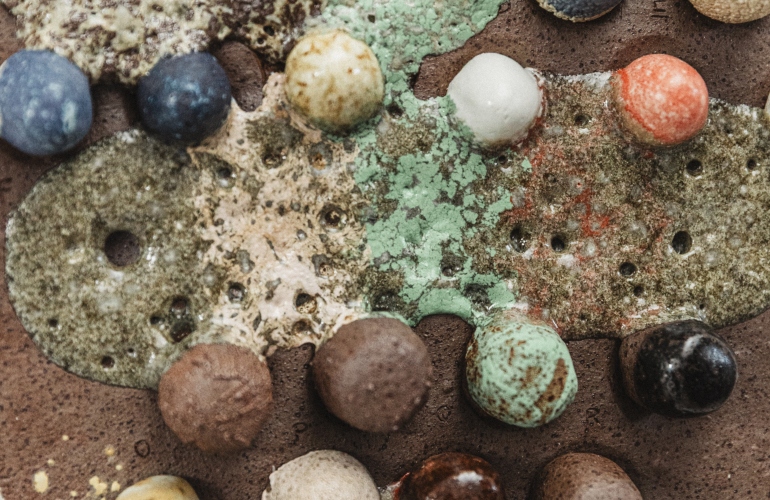
SO: So you’re interested in clay as a site where early known forms of written communication were developed. Could you talk more about your own linguistic experience and how it might have inspired this interest or influenced your practice?
VDL: In terms of communication, clay is so generous. I love the way anywhere I go I can find it either in nature or buy it easily. It's cheap, accessible. People love working with it. I think it has something to do with our ancestry, with the experience of manipulating something that comes from earth. Because of this, I like organising gatherings around clay. It doesn't matter if people come from different cultures, or if verbal communication is limited, because through clay a different kind of communication emerges. There's comfort in it, people don't feel challenged or intimidated.
SO: Thinking about material ancestry, and artefacts that existed before the industrial revolution, which have sustained activities intrinsic in the development of societies, do you ever view your work as a refusal to a globalised system of mass production?
VDL: Oh yeah, yeah. For obvious reasons, I do think capitalism is so unfair, so cruel. Look at the world. We could live in such a beautiful place but we don't. It's really sad. So I love working with a material that is so wise. And I like basic things and I want to live a basic life. I'm trying to be as thrifty as possible. I'm super proud of this, its my approach to life in general. As a person.
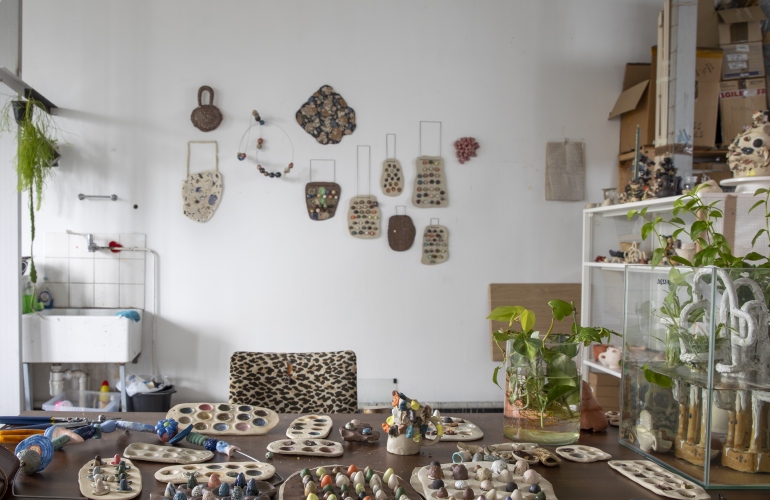
SO: Ideas of communication, material history, environment, and community are all very present in your practice. In the context of the exhibition at TBG+S, I was wondering how you feel those ideas might take shape?
VDL: It will definitely take the form of an installation, my exhibitions usually do. I’m drawn to creating spaces where people can walk around. I've been thinking a lot about the concept of transitional space, introduced by the English paediatrician Donald Winnicott. He describes it as the space between an inner and external reality, the place where culture, play, philosophy, and politics begin to take shape. So, when a baby is born, it initially experiences itself and its mother as a single unit. At a certain point, the child adopts an object – often something like a blanket – which acts as a bridge between itself and the mother. This object helps the child understand separation, that it is not the same unit. Eventually, the (transitional) object disappears, but the structure remains. The idea of a bridge between the inner and outer reality – this transitional space – stays with all of us throughout life. I am interested in building these spaces, physically, translating a mental and emotional space into something people can inhabit.
I see my installations as a tangible expression of my lived experience, born from the interplay between my inner culture – Spanish/Catalan – and the newer reality that I encounter in Ireland. I generate these spaces with objects, ideas, experiences, experiments and interactions. I want people to experience that feeling, or at least try to navigate this transitional space. The exhibition will also be full of the latest experiments. I’ve been testing glazes and clays from different locations. The results are endlessly fascinating, in part because the high temperature of the kiln does some of the work for me – you never quite know what will emerge.
SO: From what you’ve said, both relating to your work and life experience, it seems like there is a common drive towards a sense of discovery and openness to new things?
VDL: Yeah, I totally agree. I'm always exposing myself constantly to new situations. But this also relates to this idea of community, because I love social interaction. Through residencies and workshops I experience this interaction in new places. Often the work, or parts of it, have been made by other people. So, the expression of community will be very much present in the exhibition and will contain shared experiences that maybe the public may not be able to immediately interpret.
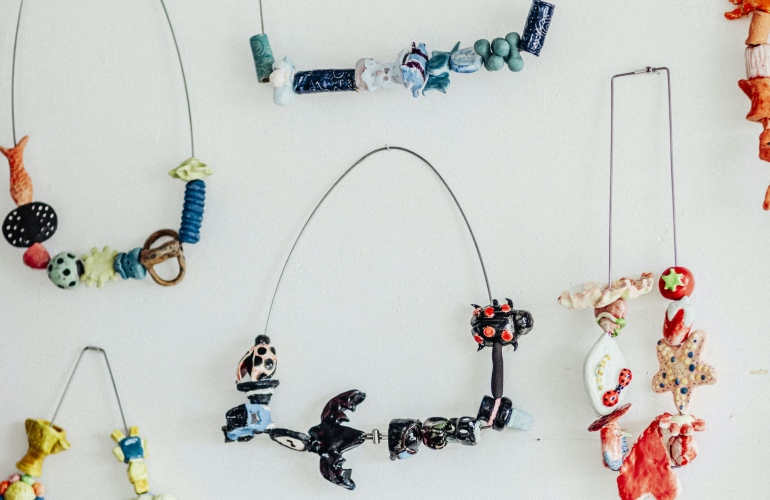
SO: And is it right to say that idea of transitional space feeds back into the exhibition, because of the exchange between your output and what you receive back from your collaborators is embedded in your work? The work almost becomes a vehicle to share these ideas and conversations making something intangible, well, tangible.
VDL: Yes. And the theme of this year’s curatorial programme is movement. I think it embraces movement in many different ways.
SO: Not just physical movement but movement of ideas, objects, materials, and transformation?
VDL: Yes, exactly. The show will also include plants, which will keep moving with the sun, the light, and there will be an exchange of carbon dioxide and oxygen. So there's lots of physical movement between different elements. Not just in a geographical sense, but through growth, transformation, transition, I see all of these kinds of changes are a form of movement.
Vanessa Donoso López's exhibition (O-O-O) takes place at Temple Bar Gallery + Studios 24 July — 20 September 2026. The exhibition is supported by an Arts Council Project Award.
Vanessa Donoso López holds a Three Year Studio Membership at TBG+S. Her recent solo exhibitions include: dlr LexIcon Gallery, Dún Laoghaire (2025); Kevin Kavanagh Gallery, Dublin (2011–2022); Galeria Herrero de Tejada, Madrid (2021); Candyland, Stockholm (2017); The LAB, Dublin (2016); Limerick City Gallery (2015).